MAEER’s Institute for Indic Knowledge Studies offers an IKS Faculty Certification course –
“Teaching Bharatiya Vijnanam as a Knowledge System”
This is a novel PG Diploma program to groom Shaastra Vidwans and Master’s graduates in Sanskrit into proficient IKS faculty who can skillfully present Bharatiya knowledge in the modern context.
Introduction
MIT IIKS announces a novel PG Diploma program to groom Shaastra Vidwans and Master’s graduates in Sanskrit into proficient IKS faculty who can skillfully present Bharatiya knowledge in the modern context.
Rationale
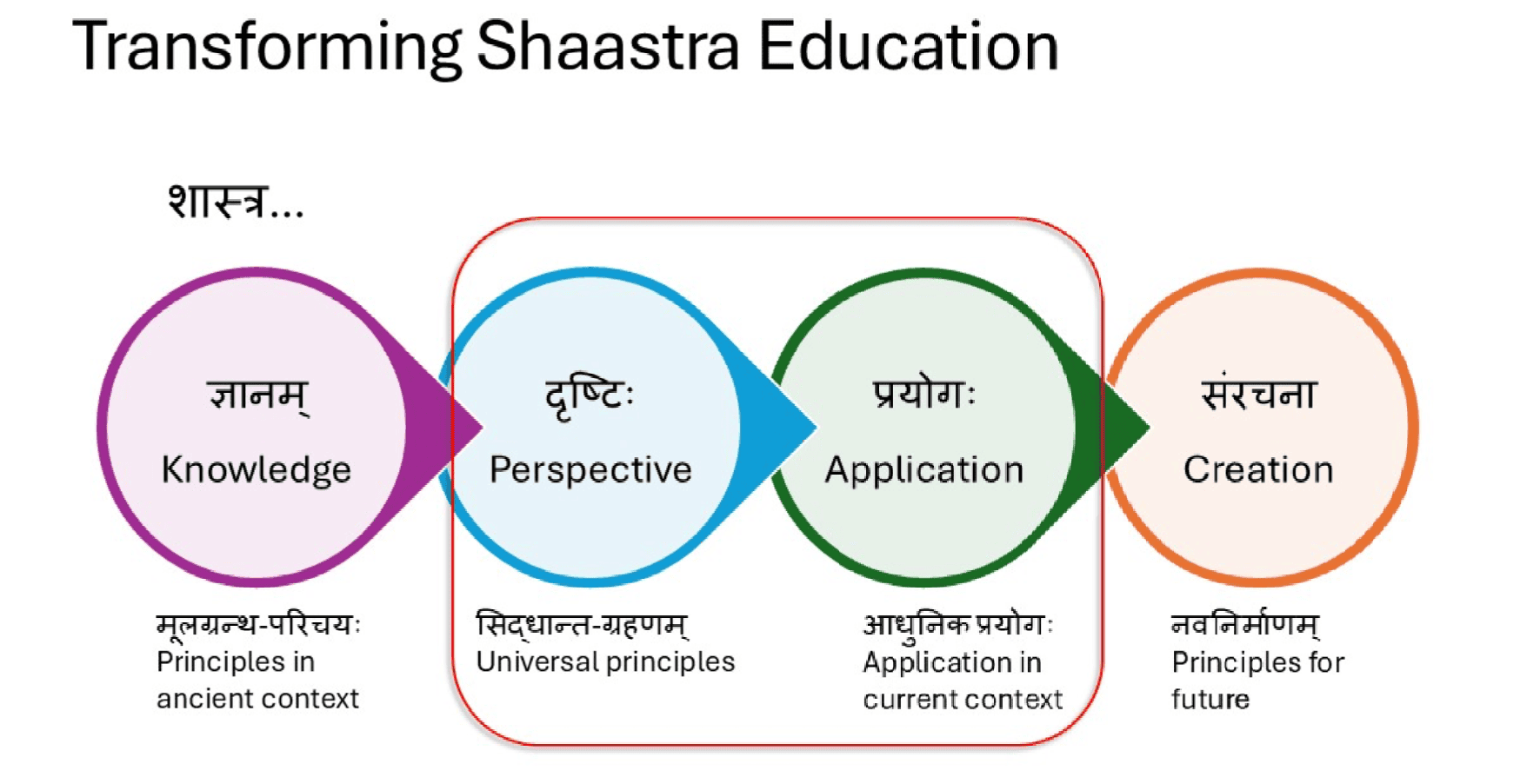
To be able to present भारतीय-विज्ञानम् in the modern context impactfully, two skills are required:
- पारम्परिक-शास्त्र-परिचयः , authentic exposure to Indic Knowledge tradition and its native literature, language and interpretation.
- शास्त्रीय-दृष्टिः, प्रयोगः , ability to apply Indian Scientific Thinking in the modern context side by side with latest Knowledge.
While the first can be acquired via traditional learning in Gurukulas or other higher education institutions, the second is a big gap that existing programs are unable to fill.
Transforming Shaastra vidwans into contemporary IKS faculty, experts and innovators requires special training in the second aspect.
MIT IIKS Faculty Training Program in IKS caters to this requirement.
Program Overview
- Name: IKS Faculty Certificate Program
- Duration: 9 months
- Credits: 10 (1 credit = 10 classes @ 1.5hrs / class.
- Program Fee: ₹19000/- (or 190 USD) + 18% GST
- Medium of Instruction: Sanskrit with occasional English
- Prerequisites:
- Acharya-level proficiency in at least one Shaastra or
- MA Sanskrit in Sanskrit medium
- Delivery: Online classes, assignments and final project-based assessment
Benefits to Attendees
- Visiting faculty and Teaching Assistant positions at MIT IIKS
- Research Fellowship positions in Applied IKS Research Projects at MIT IIKS
- Teaching assignments for IKS courses at a growing number of mainstream Universities and IITs in India as part of New Education Policy requirement.
Curriculum Overview
| Course Name | #credits | L-T-P Ratio | Schedule |
| शास्त्रीय-दृष्टिः : Analyzing the World from a Shaastric Lens
Prof. Dhananjay Rao and other guest faculty |
2 | 1-1-0 | Month 1 & 2, 2 classes / week
1 week break |
| प्रायोगिक-शास्त्र-शिक्षणम् : Teaching Application-oriented Self-study of Shaastra Texts
Prof. Sushama Chintalapati and other guest faculty |
3 | 1-1-1 | Month 3 & 4, 3 classes / week
1 week break |
| शास्त्रत्व-विमर्शः : A Shaastric Framework to Evaluate Theories
Dr. Vaishnavi Nishankar Intro lecture by Prof. Shrinivasa Varakhedi |
2 | 1-0-1 | Month 5, 2 classes / week
Month 6, Term Project 1 week break |
| दार्शनिक-दृष्टिः : Darshanas as Thought Modeling Paradigms
Multiple Faculty Intro lectures by Prof. Shrinivasa Varakhedi, Prof. Nagaraj Paturi |
3 | 3-0-0 | Month 7 & 8, 3 classes / week |
| Total Credits | 10 | Month 1-9 |
Indic Knowledge Landscape
Credits 2 (L-T-P 2-0-0, Lecture 30 hours)
Why should you attend?
If you are curious to know whether there is an indigenous knowledge in India and its diversity and spread of coverage, this course is for you. It will demystify the various sources from vedas to folklore encompassing Indian culture in just 30 hours. You will get to know what is the subject matter of the Vedas, Upanishads, Shastras, Puranas etc., in a way you can relate to modern knowledge.
Course Objectives
To introduce learners to the landscape of Vedic literature with broad taxonomy of Indic knowledge systems.
Learning Outcomes
- Knowledge of the sources of Vedic knowledge
- Comprehension of the seamless nature of Vedic knowledge
- Understand the purpose and utility of Vedic knowledge systems in enriching human life
Indic Reasoning and debating
Credits 2 (L-T-P 2-0-0, Lecture 30 hours)
Why should you attend?
Have you ever felt that something you read on social media does not make any logical sense but do not know why? Have you felt the need to win arguments with friends regardless of their motive of argument? Did you know that there are sixteen types of mistakes one can commit and you can counter any opponent in a debate by learning India’s celebrated science of debate?
If so, this course is for you. It will make you appreciate why India was the capital of knowledge and debates for millennia and why people came from all over the world to study here. This course will introduce Tarka – The Indian logic system and methodology of structured debate.
After completing this course you can exactly pinpoint fallacies in social media arguments.
Course Objectives
- Ability to make use of debate exchanges and definitions and classification systems drawn from Indic manuals, learners understand the systematic process to challenge and defend assertions made in the course of debate.
Learning Outcomes
Learner transforms into a persuasive communicator with ability to-
- Defend statements using clear, logical reasons
- Choose relevant statements to defend
- Support the arguments with well-chosen evidence, which is explanatory and thoroughly analyzed
The structure and method of Indic shastras
Credits 2 (L-T-P 2-0-0, Lecture 30 hours)
Why should you attend?
Did you know that India is unique in having a science of how to do scientific enquiry? All Indian sciences follow a standard template that enables the systematic mining of Indic texts. If you know this template you can understand any shastra(Indic sciences) easily. It also helps in artificial intelligence where knowledge representation is crucial.
Course Objectives
To understand the exposition style common to all Indian Shaastras or scientific treatises. This throws light on Bhaaratiiya method of scientific discourse.
Learning Outcomes
- Ability for independent study of Indic shaastra texts to explore contemporary relevance
- Ability to navigate Indic texts for concept search and knowledge mining applications
- Ability to paraphrase Indic shaastra content to novice mainstream-educated audience
Vedic human psychology
Credits 3 (L-T-P 3-0-0, Lecture 45 hours)
Why should you attend?
Who does not want to be happy all the time? But we are constantly surrounded by things that make us unhappy. What is in us that causes grief. Is it the outside circumstance or something in us that responds? Who am I? How Many Grades of Happiness exist? Why do I like some things and do not like others? How to help others in distress?
The answer to all these questions was the central pursuit of India for millenia. India offers the most comprehensive understanding of human nature that is central to all aspects of human life. This course gives you the essence of this knowledge without overwhelming you with the details.
It unifies spirituality, religion, psychology, aesthetics by enunciating their common underlying principles.
Course Objectives
To give a basic understanding of human psychology and the motives of human behavior. To serve as the foundation for all humanities disciplines. This course integrates several western models of psychology with a common taxonomy derived from Vedic perspective. It also introduces a novel Vedic model derived from several Vedic sources including Upanishads, Sankhya-Yoga, Tantra, Bhaagavatam, Jyotisha, Natyashaastra and Mimaamsa.
Learning Outcomes
After completion of this course students will be able to
- Comprehend the basic meaning & nature of western psychology
- Compare and contrast various paradigms of western psychology
- Understand and evaluate various fundamental concepts of Vedic psychology
- Juxtapose western and Vedic understanding of human personality
- Diagnose various psychological issues and create an intervention plan by integrating western and Vedic principles
Scientific thinking
Credits 2 (L-T-P 2-0-0, Lecture 30 hours)
Why should you attend?
Modern-day parents want their children to imbibe scientific thinking and be innovators in whatever area they choose to pursue. However, today’s school education system focuses on informing the findings of science but not the method of scientific thinking and model-based reasoning in a formal way. This course hones three key skills of scientific thinking, namely, abstraction, classification and inference essential to become a creative scientist.
This course introduces India’s science of building scientific models and analyzing the soundness of any theory. It helps one become a discerning scientist and appreciate scientific works better.
Course Objectives
To elucidate the fundamental aspects of knowledge, its creation, its process and the method of scientific inquiry. To introduce the Navya Nyaya approach of model building.
Learning Outcomes
After the completion of this course students will be able to
- Understand Model based reasoning as the method of all scientific inquiry
- Assess the robustness of scientific models according to criteria laid out in Vedic scientific system
- Build robust scientific models for use in simulating real world systems
- Recontextualize Vedic shaastras as scientific models for a contemporary application.
Related products
-

Jyothisha Advanced
₹5,400.00 (+ 3.5% online fee) Quick View
